
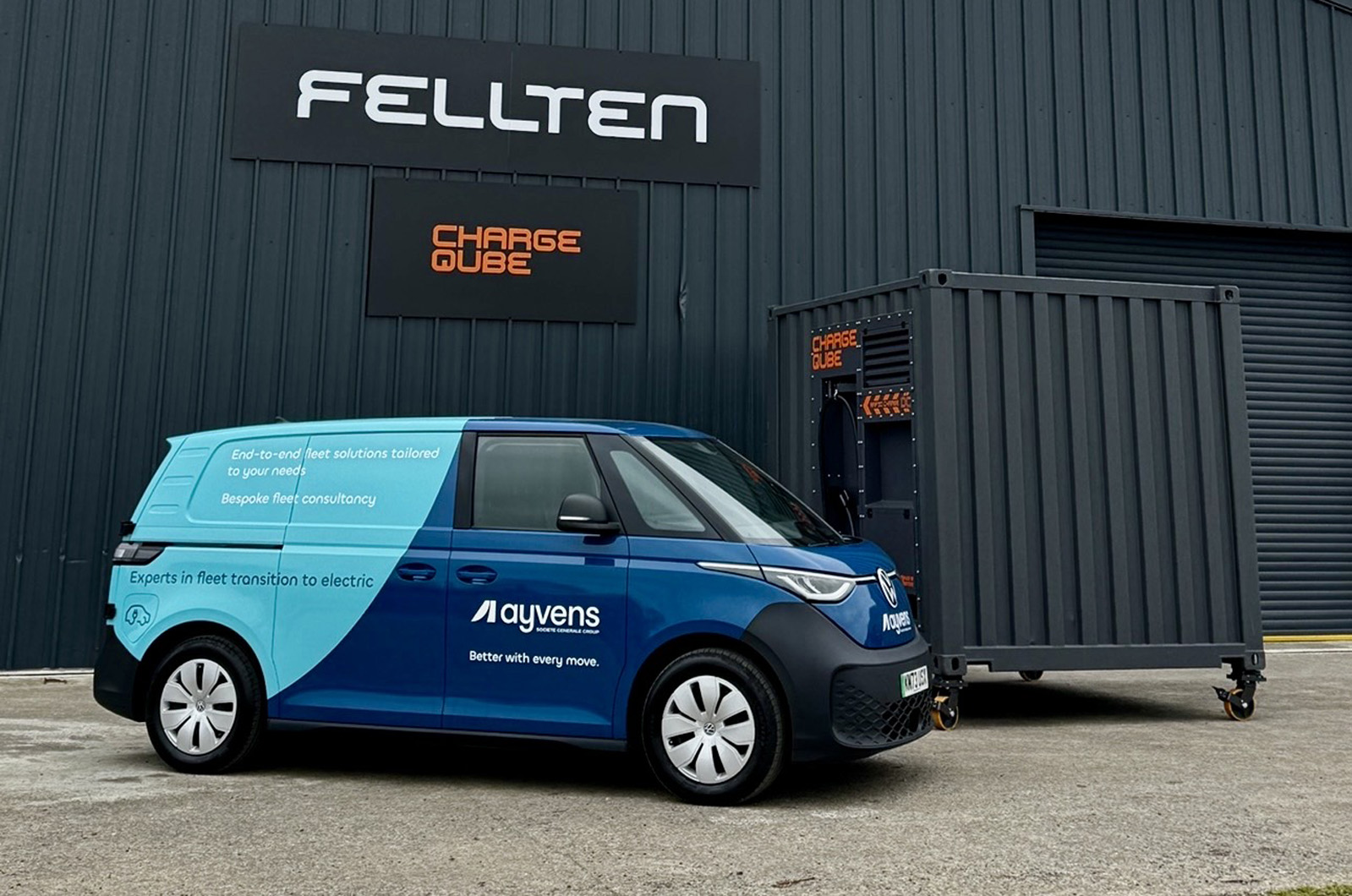
Ayvens and Fellten team up to provide large EV fleets with quick-install charger connections Fleet company Ayvens and electric car tech firm Fellten have partnered to supply containerised…
Ayvens and Fellten team up to provide large EV fleets with quick-install charger connections Fleet company Ayvens and electric car tech firm Fellten have partnered to supply containerised EV chargers for company car fleets, aiming to bypass grid upgrade queues and reduce drivers’ reliance on expensive public charging networks.
Russ Boulton, Ayvens’s head of customer data and innovation, said the two companies will work with customers to identify “pinch points” in charging demand – using fleets’ telematics data where available – and offer Fellten Charge Qubes where sites have inadequate power to meet them. Charge Qubes combine AC or DC charging and a battery pack with up to 1MWh of storage capacity into a single unit.
There’s no groundwork required and they plug into a three-phase supply, which means they can be deployed within two hours if the connection is already available, and relocated if necessary ––though they are also designed as a permanent solution. Data centres, EV charging and industry have put pressure on grid installation upgrades. A recent government release claimed demand increased by 460% in the first half of 2025, with projects now taking up to 15 years to complete.
For EV fleets, this leaves drivers relying on public charging that can be 13 times more expensive than the cheapest home energy rates. Boulton said Charge Qubes offer fleets the advantage of drawing much lower peak power than a DC charger, enabling them to buy energy when it’s cheapest and greenest and then dispense it when drivers need it – savings that could be passed on to company car drivers. The need is growing, he said.
Whereas early adopters tended to be drivers who could plug in at home and access cheap energy rates, fleets are increasingly restricting company car choice lists to plug-in hybrid and electric cars, and facing pushback from those who have to rely on public networks.
This is a source-linked briefing. Read the original report from Autocar .